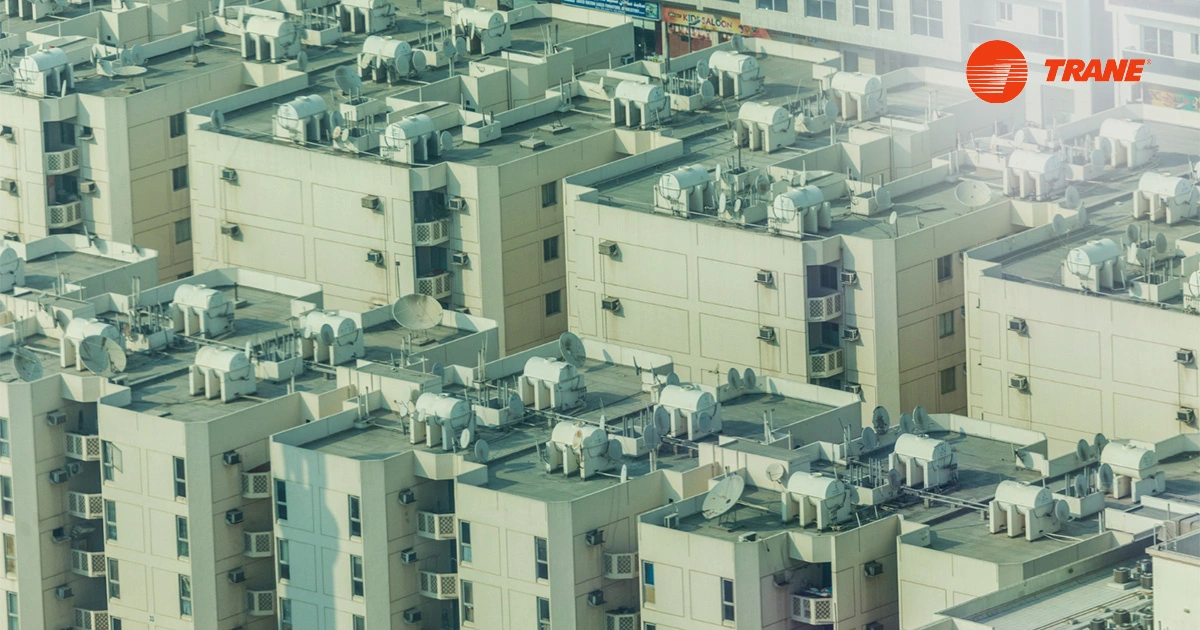
District cooling system infrastructure has become an essential part of modern urban development in the United Arab Emirates. As cities such as Dubai and Abu Dhabi continue to expand with large commercial districts, hospitality complexes, and mixed-use developments, cooling demand across buildings is rising rapidly. Centralised cooling networks allow developers and facility operators to distribute chilled water efficiently across multiple buildings while reducing energy consumption and infrastructure complexity. Trane UAE supports these large-scale cooling environments through advanced chiller technology, engineered cooling systems, and flexible cooling services designed for demanding climate conditions.
Cooling infrastructure in the UAE must be designed to perform reliably under extreme heat, fluctuating building loads, and continuous operation throughout the year.
Cooling Challenges in Large UAE Developments
Large developments in the UAE face several cooling challenges that require sophisticated infrastructure.
Extreme Climate Conditions
Outdoor temperatures during summer regularly exceed 40°C. These conditions create intense cooling demand across hotels, offices, retail centres, and residential towers.
High-Density Urban Projects
Major developments often combine commercial offices, shopping areas, hospitality venues, and residential spaces within a single district. Each of these environments has different cooling requirements.
Continuous Cooling Demand
Unlike cooler climates, many buildings in the UAE require cooling for most of the year. Systems must therefore operate reliably under sustained loads.
Rapid Infrastructure Expansion
Cities across the UAE continue to grow rapidly. Cooling systems must be capable of expanding as new buildings connect to existing infrastructure.
These challenges make efficient and scalable cooling systems critical for maintaining stable indoor environments.
Extreme Heat and Cooling Demand in the UAE
Cooling demand in the United Arab Emirates is heavily influenced by the country’s extremely hot climate. The World Meteorological Organization (WMO) reports that temperatures across the Arab region have been rising faster than the global average, increasing the need for reliable cooling infrastructure in cities and urban developments. For countries such as the UAE, where summer temperatures frequently exceed 40°C, this trend is driving higher demand for efficient cooling systems that can support commercial buildings, industrial operations, and large urban districts.
Source: https://wmo.int/news/media-centre/temperature-increase-accelerating-arab-region-escalating-impacts
How Centralised Cooling Networks Operate
Centralised cooling networks generate chilled water at a central plant and distribute it through insulated pipelines to connected buildings. Each building uses heat exchangers to transfer cooling into its internal air conditioning systems.
This design offers several advantages.
Improved Energy Efficiency
Large central cooling plants can operate more efficiently than multiple independent building chillers.
Reduced Equipment Footprint
Buildings connected to a central cooling network do not require large on-site chiller plants, freeing valuable space for other operational uses.
Simplified Maintenance
Centralised equipment allows facility operators to manage maintenance more effectively.
Scalable Infrastructure
New buildings can connect to the network without requiring entirely new cooling plants.
These advantages have made centralised cooling systems a key component of modern infrastructure planning in the UAE.
Trane Technologies Supporting Central Cooling Infrastructure
Trane provides advanced technologies that support reliable cooling across large developments.
High-Efficiency Chillers
Trane centrifugal and air-cooled chillers are designed for high-capacity cooling applications and stable performance under varying load conditions.
Advanced Control Systems
Intelligent control platforms allow operators to monitor system performance and optimise cooling distribution across connected buildings.
Integrated Cooling Equipment
Trane cooling solutions can integrate with building management systems, enabling facility managers to manage energy consumption and cooling output effectively.
Engineering and System Expertise
Trane works with developers, facility operators, and infrastructure planners to design cooling solutions suited to the specific needs of each project.
This integrated approach ensures cooling infrastructure performs reliably even in demanding environments.
Operational Challenges That Require Flexible Cooling Support
Even well-designed cooling infrastructure must be prepared to handle operational challenges.
Maintenance Shutdowns
Cooling plants occasionally require maintenance or equipment upgrades to maintain efficiency.
Peak Demand Periods
Extreme weather or large events can temporarily increase cooling demand.
New Infrastructure Connections
When new buildings connect to existing cooling networks, demand can temporarily exceed installed capacity.
Unexpected Equipment Issues
Like all mechanical systems, cooling equipment may occasionally experience operational issues.
Flexible cooling solutions help operators maintain stable conditions during these periods.
Supporting Construction and Temporary Installations
Large development projects in the UAE frequently require temporary cooling during construction phases.
Construction sites often include temporary offices, worker accommodation areas, and enclosed spaces that require cooling before permanent infrastructure is installed.
Temporary cooling equipment allows developers to maintain safe working environments while permanent systems are being built or commissioned.
Trane provides flexible cooling solutions designed to support these environments.
Planning Cooling Infrastructure for Future Growth
Urban development across the UAE continues to expand, with new projects increasing the demand for reliable cooling infrastructure.
Developers and infrastructure planners must consider long-term cooling requirements when designing large projects.
Key considerations include:
- projected cooling demand growth
- energy efficiency targets
- infrastructure expansion capability
- operational reliability
Trane works with stakeholders to design cooling systems that support both current operational needs and future growth.
Reliable Cooling as Part of Urban Infrastructure
Cooling infrastructure has become as essential to cities as electricity, water, and transportation networks.
Reliable cooling ensures:
- safe working environments
- comfortable public spaces
- stable building operations
- protection of equipment and infrastructure
For rapidly growing cities like those in the UAE, investing in efficient cooling systems is critical to supporting sustainable development.
Conclusion
As urban development continues to accelerate across the United Arab Emirates, reliable cooling infrastructure remains essential for maintaining safe and comfortable environments. Trane UAE supports these developments through advanced technologies designed for large projects built around a district cooling system, helping operators maintain efficiency, reliability, and scalability.
For environments that require additional airflow and temporary cooling support in open or semi-open spaces, facilities may also rely on flexible solutions such as outdoor air cooler rental, ensuring that cooling needs can be addressed even in challenging outdoor environments.